Industry white paper
The 84% Problem: Why Most UK Retail Media Spend Is Wasted
£4.8 billion will flow into UK retail media in 2026. Research shows 84% of it will reach shoppers who have no intention to buy. There is now a technology that solves this, and it's only available through one network in the UK.
The core argument in four sentences
The timing problem
Traditional retail media targets who has bought a category, not who is about to buy it. 84% of impressions reach shoppers who purchased recently and won't replenish for weeks. The spend is structurally wasted.
The solution exists
AI Consumption Intelligence learns individual replenishment cycles per shopper per category. It identifies the 7-day "in-market window" before a purchase becomes inevitable. Brands reach shoppers at the moment of depletion.
Convenience data is the key signal
The purchase patterns of the 41 million weekly convenience shoppers are uniquely clean, high-frequency, immediate consumption, habit-driven. This data generates more accurate depletion models than weekly supermarket shops.
Only one UK network has this
Corner Collective's AI Consumption Intelligence is patent pending. The DRS confirmation signal (available from October 2027) will make our depletion prediction deterministic rather than estimated. No other UK RMN is building this.
The £4 Billion Timing Error Hiding in Plain Sight
The UK retail media market will reach £4.8 billion in 2026. This number is frequently celebrated as a sign of channel maturity. What it obscures is a fundamental measurement problem that every brand buying retail media is already experiencing, even if they haven't named it: they are consistently reaching the wrong shoppers at the wrong time.
Standard retail media audience construction works backwards. A brand wants to reach "toothpaste buyers." The data platform returns everyone who has purchased toothpaste in the last 90 days. The campaign runs. But here's the problem: if Sarah bought toothpaste three days ago, she won't need another tube for six weeks. Her impression is wasted. And across a national FMCG campaign, research shows 84% of targeted media spend reaches shoppers outside their replenishment window.
Standard Retail Media: The Waste Problem
Of every £100 spent on a standard retail media audience targeting recent category buyers:
Corner Collective internal analysis. Methodology: average product replenishment cycles across top 20 FMCG categories vs. standard 90-day audience lookback windows used by major UK RMNs.
This is not a targeting problem in the conventional sense. The audience contains the right people, it just contains them at the wrong moment. And because standard RMNs measure success by reach, clicks, and attributed sales (often including existing purchase behaviour), this structural timing waste is rarely surfaced in post-campaign reporting. Brands assume the medium is working sub-optimally. In reality, the audience construction methodology is the problem.
“62% of retail media buyers are dissatisfied with their RMNs' performance measurement. The gap between what's promised and what's delivered is real, and it's getting wider as budgets scale.”
A Market Growing Faster Than Anyone Can Measure
Before addressing the solution, it's worth understanding the scale of what's at stake. UK retail media has grown nearly sixfold in seven years. Global spend will surpass television advertising by 2028. And the UK (despite being a fraction of the US market by population) generates more retail media activity per capita than any European market.
UK Digital Retail Media Spend Growth (2019–2026)
Source: Retail Media Age / GroupM 2025. 2026 projection. CAGR 2019–2026: ~29%.
AI Consumption Intelligence: Targeting the Moment Before They Buy
Corner Collective's AI Consumption Intelligence module solves the timing problem structurally rather than incrementally. Instead of asking "who has bought this category?", a backwards-looking question, it asks "who is about to buy this category?", a forward-looking prediction trained on individual purchase frequency data.
The mechanism is straightforward: the AI ingests individual shopper transaction histories across all categories purchased at partner retail locations. It learns each shopper's personal replenishment cycle, not a category average, but an individual cadence. Sarah buys toothpaste every 42 days. It's been 38 days. Sarah enters the "in-market window." The model triggers her inclusion in the relevant FMCG audience segment. The brand's media reaches her at the exact moment she is most likely to purchase.
Impression → Purchase → Consumption → Return → Retarget
Shopper buys Product X. ePOS data captured. Individual replenishment clock starts. Shopper profile updated in real-time.
AI calculates how long Product X lasts for this specific shopper based on their historical frequency. 42-day cycle for Sarah. 29-day cycle for Mark.
Shopper enters predicted 7-day replenishment window. Automatically added to "in-market" audience segment. Available for targeting via The Trade Desk, DV360, Yahoo DSP.
DRS: when shopper returns empty bottle at QUBE machine (Oct 2027), depletion is confirmed deterministically. Model becomes certain, not predicted. No other RMN has this.
Pattern breaks reveal new babies, dietary changes, household events. Brands activate on life moments in real-time. Standard RMNs see purchase history. CC sees life trajectory.
41 Million Shoppers. The Signal Supermarkets Don't Have.
A weekly supermarket shop is a planned event. A shopper buys in bulk, varying their basket significantly each visit based on promotions, meal planning, and household size changes. Replenishment frequency is low (1x per week) and purchase quantities are variable, making predictive modelling noisy.
A convenience store purchase is the opposite: a high-frequency, low-quantity, immediate consumption event. The shopper buying a Lucozade at 7am three days a week is exhibiting one of the cleanest behavioural patterns available in consumer data. This is exactly the input that makes AI depletion prediction precise rather than approximate.
41 million unique shoppers visit UK convenience stores every week, generating the high-frequency transaction data that trains accurate individual replenishment models.
More data points per shopper per week. Depletion models trained on 15-20 purchase events per month vs. 4-5 for a supermarket shopper. Significantly higher prediction accuracy.
Immediate consumption purchases have predictable, repeatable replenishment cycles. "Grab and go" is a habit, not a planned shop. AI learns habits faster than intent.
£54 billion in transactional data with near-zero current monetisation. Every unit of this data becomes more valuable as the AI model develops. Network effects compound the moat.
How UK Retail Media Networks Compare on What Actually Matters
Not all retail media networks are equal. As brands face pressure to reduce the number of RMNs they work with (down from 58% working with a new RMN in 2023 to just 35% in 2024) the capability question has become the central procurement decision. The table below benchmarks the capabilities that differentiate high-performing RMNs from commodity inventory sellers.
| Capability | Tesco (Dunnhumby) | Sainsbury's (Nectar360) | Corner Collective |
|---|---|---|---|
| Purchase data at individual level | ACTIVE | ACTIVE | ACTIVE |
| Depletion / replenishment prediction | PENDING | PENDING | ACTIVE |
| DRS consumption confirmation signal | PENDING | PENDING | ACTIVE |
| Life stage detection | IN DEVELOPMENT | IN DEVELOPMENT | ACTIVE |
| Offsite DSP connectivity | ACTIVE | ACTIVE | ACTIVE |
| Convenience / forecourt coverage | IN DEVELOPMENT | PENDING | ACTIVE |
| Digital coupon clearing | LIVE | LIVE | ACTIVE |
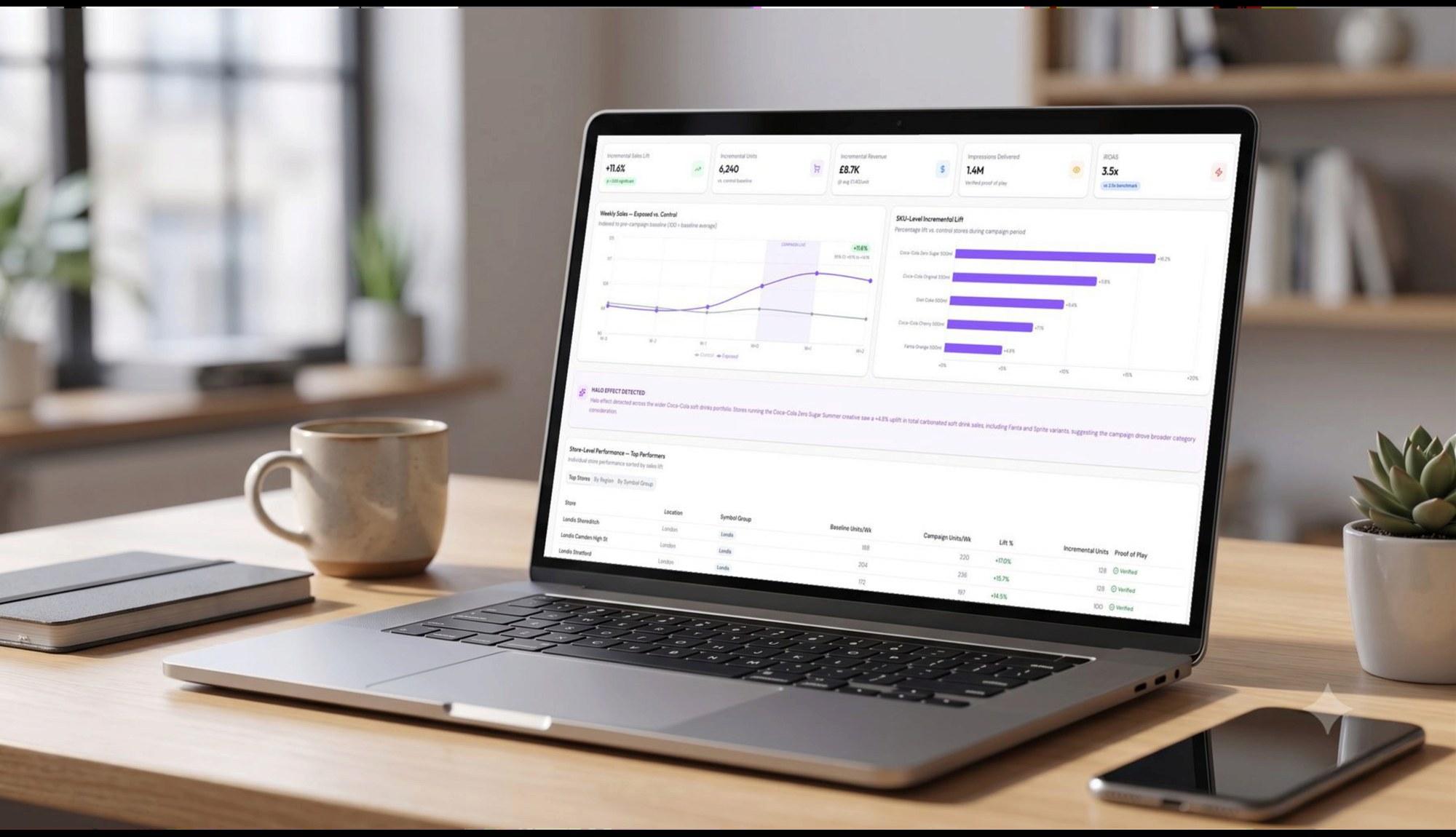
| Incremental sales attribution (iROAS) | ACTIVE | ACTIVE | ACTIVE |
| Non-Amazon independent channel | PENDING | PENDING | ACTIVE |
| Build cost to retailer partner | PENDING | PENDING | ACTIVE |
The key observation from this comparison is not that Corner Collective competes directly with Tesco's retail media network at grocery scale, it doesn't, and doesn't need to. The comparison demonstrates that the capabilities that distinguish premium-CPM retail media from commodity inventory are precisely those that the convenience channel enables and the major grocery networks have not built.
Three Verticals. One Infrastructure. Different Entry Points.
Symbol Groups & Regional Supermarkets
Your £54B+ GMV is generating zero media revenue today. Your FMCG suppliers already have retail media budgets, they just can't spend them with you. Corner Collective builds the infrastructure to change that in 8-12 weeks, at zero cost to you.
Get the Symbol Group Brief →Fuel Retailers & Forecourt Operators
BP did this at 8,500 US locations in 2025. Your UK estate has the loyalty data, the dwell time at pump, and the impulse purchase frequency to command premium CPMs. The UK version needs to be built. Corner Collective is building it.
Get the Forecourt Brief →FMCG Brands & Agency Planners
Signed LOIs confirm that major agency trading desks are ready to activate. If you are spending retail media budgets with networks that can't tell you when your audience last ran out of product, Corner Collective is your alternative.
Get the Advertiser Brief →Stop Paying for the Wrong Shopper at the Wrong Time
Corner Collective's AI Consumption Intelligence is the only UK retail media capability that targets the moment of depletion, not the moment after purchase. Book 30 minutes to see how it applies to your network or your brand.
Book a Consumption Intelligence Demo →Get in touch
Want to Learn More?
Get in touch with our team to discuss how Corner Collective can transform your retail media strategy.